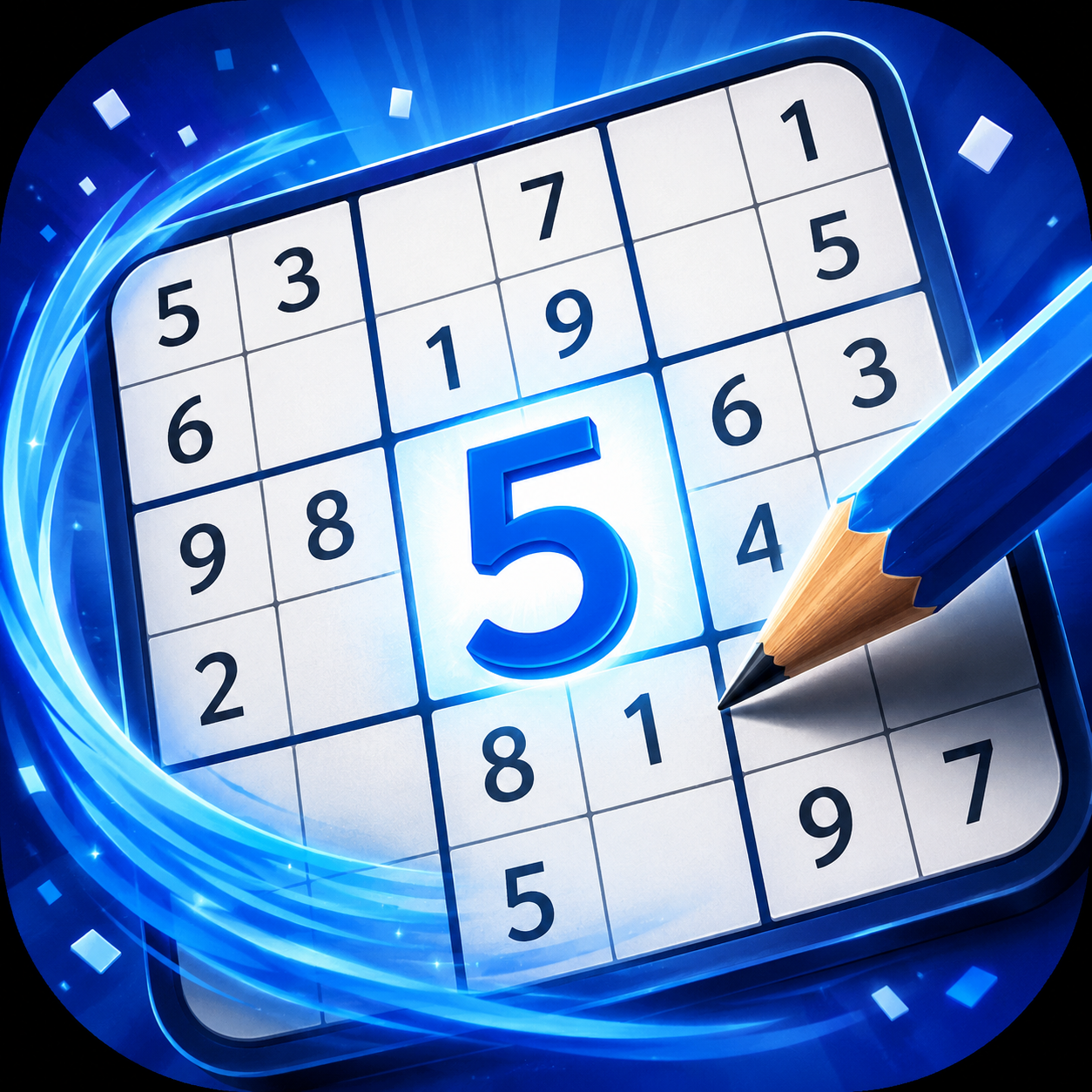
Classic Sudoku rules
A Classic Sudoku grid has 81 cells arranged in nine rows, nine columns and nine 3 × 3 boxes. Fill the grid with digits 1 through 9 while following these rules:
- Each digit appears once in every row.
- Each digit appears once in every column.
- Each digit appears once in every 3 × 3 box.
- Starting clues are fixed. A well-formed puzzle has one solution.
Classic Sudoku solving strategies
Work from the clearest deduction to the most advanced. After placing a digit, rescan its row, column and box because one placement can create several new opportunities.
- Scanning and crosshatchingChoose one digit and note where it already appears in neighboring rows and columns. By eliminating forbidden cells inside a box, you may leave only one valid position.
- Naked singleIf a cell has only one possible digit after checking its row, column and box, place that digit immediately.
- Hidden singleA cell may contain several candidates, yet one digit may appear as a candidate only once in a row, column or box. That digit is forced into that location.
- Candidate notesWrite only the digits that remain possible in unresolved cells. Remove candidates whenever the same digit is placed in the cell’s row, column or box.
- Naked pairs and triplesIf two cells in a unit contain exactly the same two candidates, remove those digits from the other cells in that unit. The same idea works with three cells and three candidates.
- Box-line interactionIf every candidate for a digit inside a box lies on one row or column, remove that digit from the rest of the same row or column outside the box.
- X-WingFor one digit, if two rows each have exactly two candidates in the same two columns, remove that digit from other cells in those columns. Use this only after verifying your notes.
Killer Sudoku rules
Killer Sudoku follows every Classic Sudoku rule and adds dotted cages. The small number in a cage is the required sum of the digits inside it.
- Digits in a cage must add up to the displayed total.
- A digit cannot repeat inside the same cage.
- Rows, columns and boxes must still contain digits 1 through 9 without repetition.
- A cage may cross box boundaries; cage rules add constraints but never replace Classic Sudoku rules.
Killer cage sum limits
| Cells | Minimum sum | Maximum sum |
|---|---|---|
| 2 | 3 | 17 |
| 3 | 6 | 24 |
| 4 | 10 | 30 |
| 5 | 15 | 35 |
| 6 | 21 | 39 |
| 7 | 28 | 42 |
| 8 | 36 | 44 |
| 9 | 45 | 45 |
These limits assume distinct digits from 1 to 9. For example, a two-cell cage totaling 3 must be 1 + 2, while a two-cell cage totaling 17 must be 8 + 9.
Killer Sudoku solving strategies
Keep switching between cage arithmetic and Classic Sudoku logic. Cage combinations reduce candidates, and those reduced candidates unlock rows, columns and boxes.
- Extreme sumsVery low and very high cage totals have few combinations. Start with two-cell cages near 3 or 17 and three-cell cages near 6 or 24.
- List combinationsFind sets of distinct digits that make the cage total. Order does not matter at first; use row, column and box restrictions to place each digit later.
- The 45 ruleDigits 1 through 9 sum to 45, so every complete row, column and box totals 45. Subtract fully contained cages to calculate a partial cage or remaining cell.
- Cage intersectionsWhen a cage crosses a row, column or box boundary, compare the inside and outside portions. A known partial sum can reveal the cells that extend beyond the region.
- Innies and outiesWithin a 45-point region, add cages entering the region and subtract cages leaving it. This often determines one or two difficult cells.
- Locked candidatesA cage combination may confine a digit to one row, column or box. Apply Classic Sudoku locked-candidate logic to eliminate that digit elsewhere.
- Return to Classic logicDo not look only for sums. After every cage reduction, check for naked singles, hidden singles, pairs and box-line interactions.
What to do when you are stuck
- Confirm that every candidate note is still compatible with placed digits.
- Scan digits 1 through 9 one at a time instead of staring at the whole grid.
- Look for naked singles in cells, then hidden singles in every row, column and box.
- In Killer Sudoku, recalculate cages that already contain one or more solved cells.
- Apply the 45 rule to nearly completed rows, columns or boxes.
- Move to a different area for a few minutes; a deduction elsewhere may unlock the hard section.
Common mistakes to avoid
- Guessing too early instead of exhausting logical deductions.
- Forgetting that digits cannot repeat inside a Killer cage.
- Treating a cage as separate from its row, column and box.
- Leaving candidate notes that became impossible after a placement.
- Focusing on one area while the next deduction is somewhere else.
Sudoku strategy FAQ
Do I need to be good at math for Killer Sudoku?
No. The arithmetic is basic; the challenge is logical combinations and the interaction between cages and Classic Sudoku rules.
Which technique should I learn first?
Start with scanning, naked singles and hidden singles. Those three techniques solve many easy and medium puzzles.
Is guessing allowed?
You can test a hypothesis, but a strong solving method favors deductions. A unique-solution puzzle is designed so that a logical chain can lead to the answer.
When should I use candidate notes?
Use them when direct placements are no longer available. Keep notes clean and remove eliminated candidates immediately.
Why does every row and box total 45?
Because each contains the digits 1 through 9 exactly once, and 1 + 2 + 3 + 4 + 5 + 6 + 7 + 8 + 9 = 45.
What is the best way to improve?
Solve regularly at a slightly higher difficulty, review where you became stuck and learn one new technique at a time.
Read this guide in another language
Last updated: